
Speed as a Competitive Capability

As products become increasingly software-defined, the ability to develop and adapt quickly is becoming an important source of competitive advantage. Markets, technologies and customer expectations can shift significantly during a development cycle, increasing the cost of slow feedback and late decisions. Companies that learn earlier can reduce uncertainty, adapt faster to change and bring more relevant products to market.
Speed reduces the cost of uncertainty
Long development cycles increase the risk of committing to assumptions that may no longer hold when a product reaches the market. Shorter feedback loops allow critical assumptions to be validated earlier, while there is still time and flexibility to act. Development speed is therefore not only a question of efficiency. It affects a company’s ability to manage risk, allocate resources effectively and respond to changing market conditions.
“The real advantage of speed comes from validating critical assumptions earlier”
Software changes the development equation
Hardware and software evolve at fundamentally different speeds. Physical development depends on prototypes, tooling and maturity gates, while software can be developed, tested and refined continuously. As products become more software-defined, companies can use this difference to their advantage. Simulation, virtual representations and earlier integration allow development and validation to progress while hardware matures – reducing dependency on physical builds and creating more frequent opportunities to learn.
“The objective is not to make hardware move like software, but to enable learning to continue while hardware matures.”
Earlier learning enables better decisions
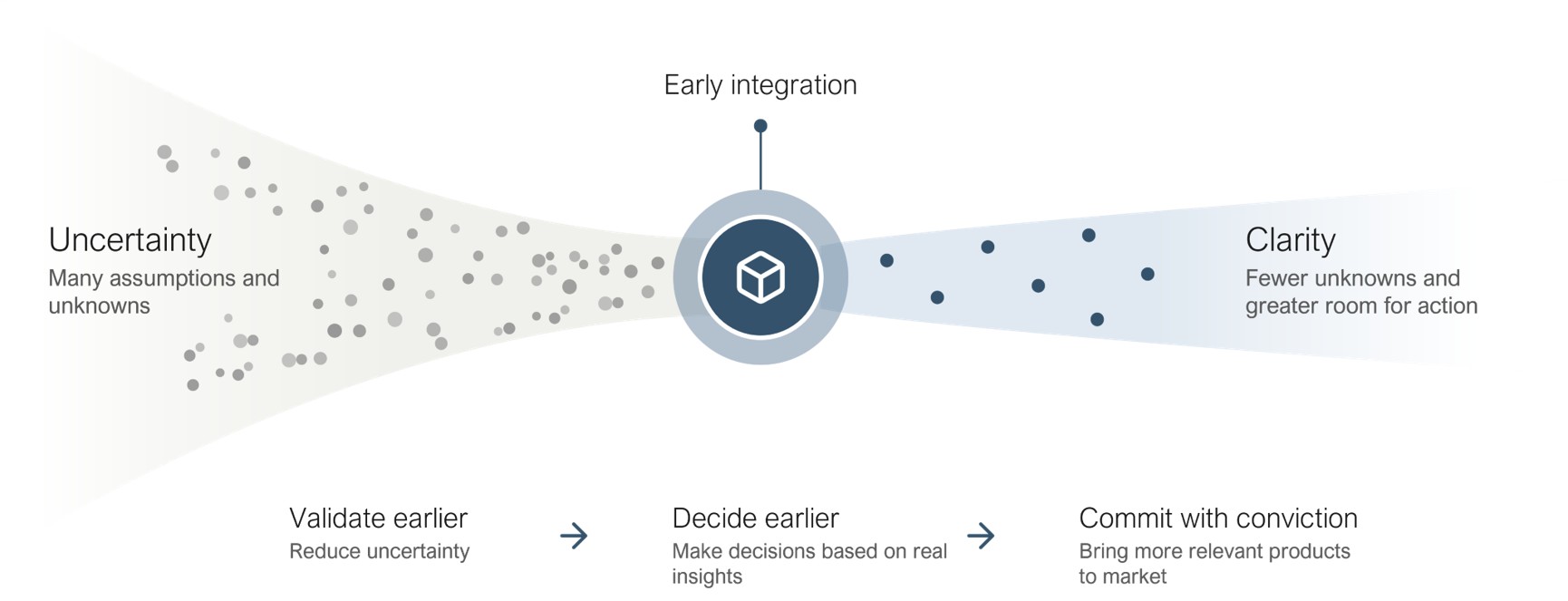
Earlier integration frontloads learning in the development process. Critical assumptions can be tested sooner, dependencies identified earlier and decisions made with better information. This reduces the risk of discovering costly late-stage changes and gives companies greater flexibility to adapt product priorities as technologies, customer needs and market conditions evolve.
Faster learning strengthens competitiveness
The companies that move fastest are not necessarily those that execute every activity faster. They are those that systematically shorten the time between assumption, validation and decision. Building this capability can reduce development risk, improve capital efficiency and increase responsiveness to market change. Ultimately, speed is less about completing development activities faster – and more about how quickly the organization can learn and act.
